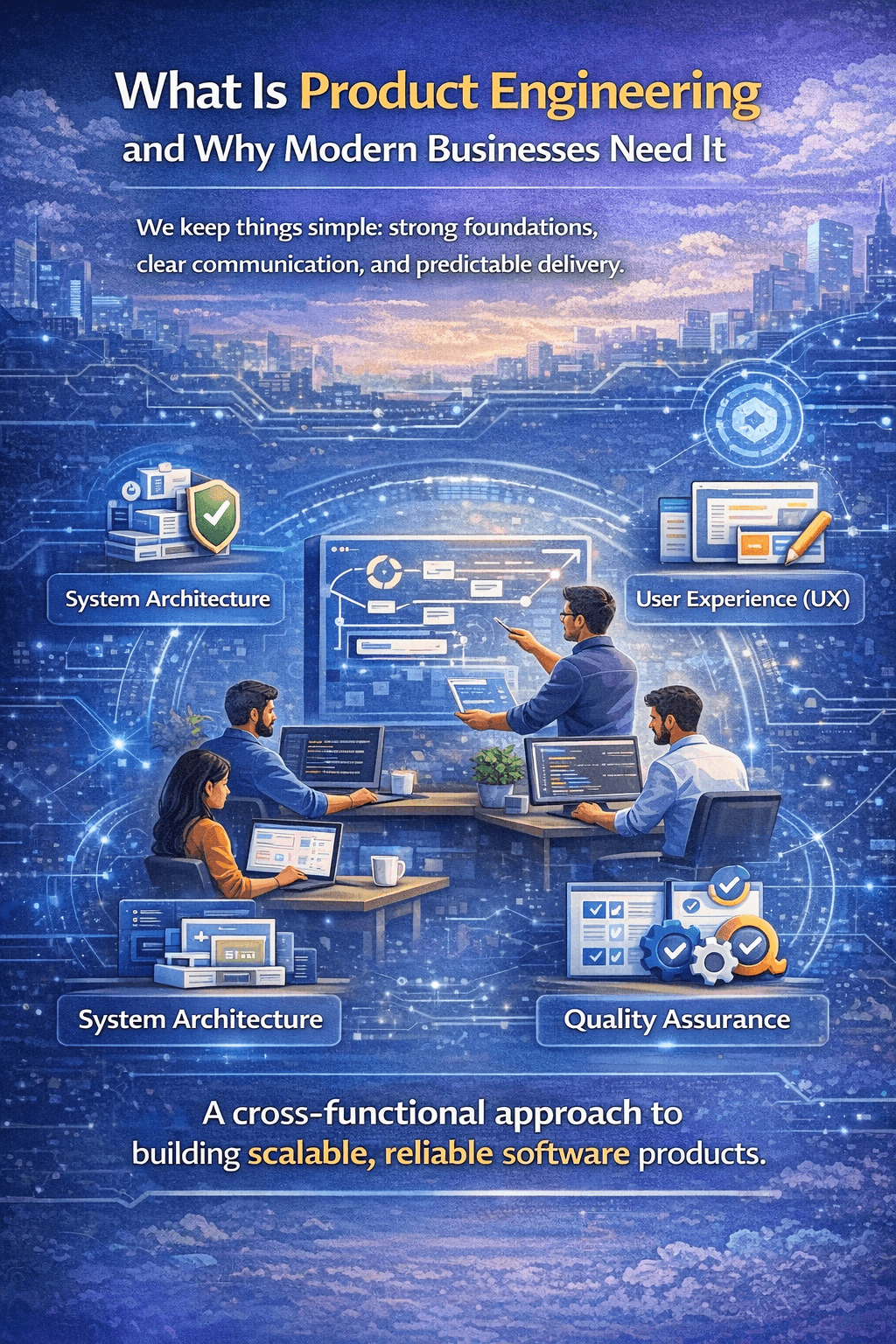
Product engineering vs traditional development
Traditional software development often focuses on delivering a set of features. Product engineering focuses on building a product that can evolve—balancing speed, quality, scalability, and long-term maintainability.
In product engineering, you design for:
- reliability in production
- clear ownership across teams
- measurable outcomes (not just output)
- sustainable velocity as the codebase grows
Why modern businesses need product engineering
Modern businesses compete on delivery speed and user experience. But shipping fast only works if the product stays stable as demand increases.
Product engineering helps you avoid the "feature factory" trap by making architecture, quality, and delivery part of the product strategy.
The real cost of "just build it" architecture
When early decisions are made only for speed, common issues appear later:
- brittle code that breaks when you add features
- unclear boundaries between UI, APIs, and business logic
- slow onboarding for new engineers
- performance regressions and rising infrastructure cost
Scalable architecture matters for growing teams
Scalable architecture is not only about handling traffic. It is also about helping teams work in parallel.
Key architectural principles:
- Clear boundaries between UI, domain logic, and data access
- Stable contracts for APIs and shared modules
- Separation of concerns so features don't become tangled
- Observability (logs, metrics, tracing) to debug quickly
What product engineering teams do differently
Product engineering teams align engineering work with business outcomes.
Typical practices include:
- define a product roadmap with engineering constraints
- build reusable components and platform capabilities
- automate testing and deployments
- measure performance and reliability continuously
Practical checklist for adopting product engineering
- Treat architecture as an ongoing activity, not a one-time phase
- Keep delivery loops short (ship small increments)
- Document decisions (lightweight ADRs) so context doesn't get lost
- Invest in CI/CD and quality gates early
- Track user impact: performance, conversion, retention
FAQs
Is product engineering only for big companies?
No. Startups benefit the most because the cost of rewriting later is high.
Does product engineering slow down delivery?
Done well, it increases delivery speed over time by reducing rework and production incidents.
What should we fix first?
Start with delivery foundations: CI/CD, monitoring, and clear boundaries in the codebase.
Next steps
If you're planning to scale your product and engineering team, focus on delivery systems and architecture that reduce friction. You can also explore more notes in our blog.